Why is SEO Important?
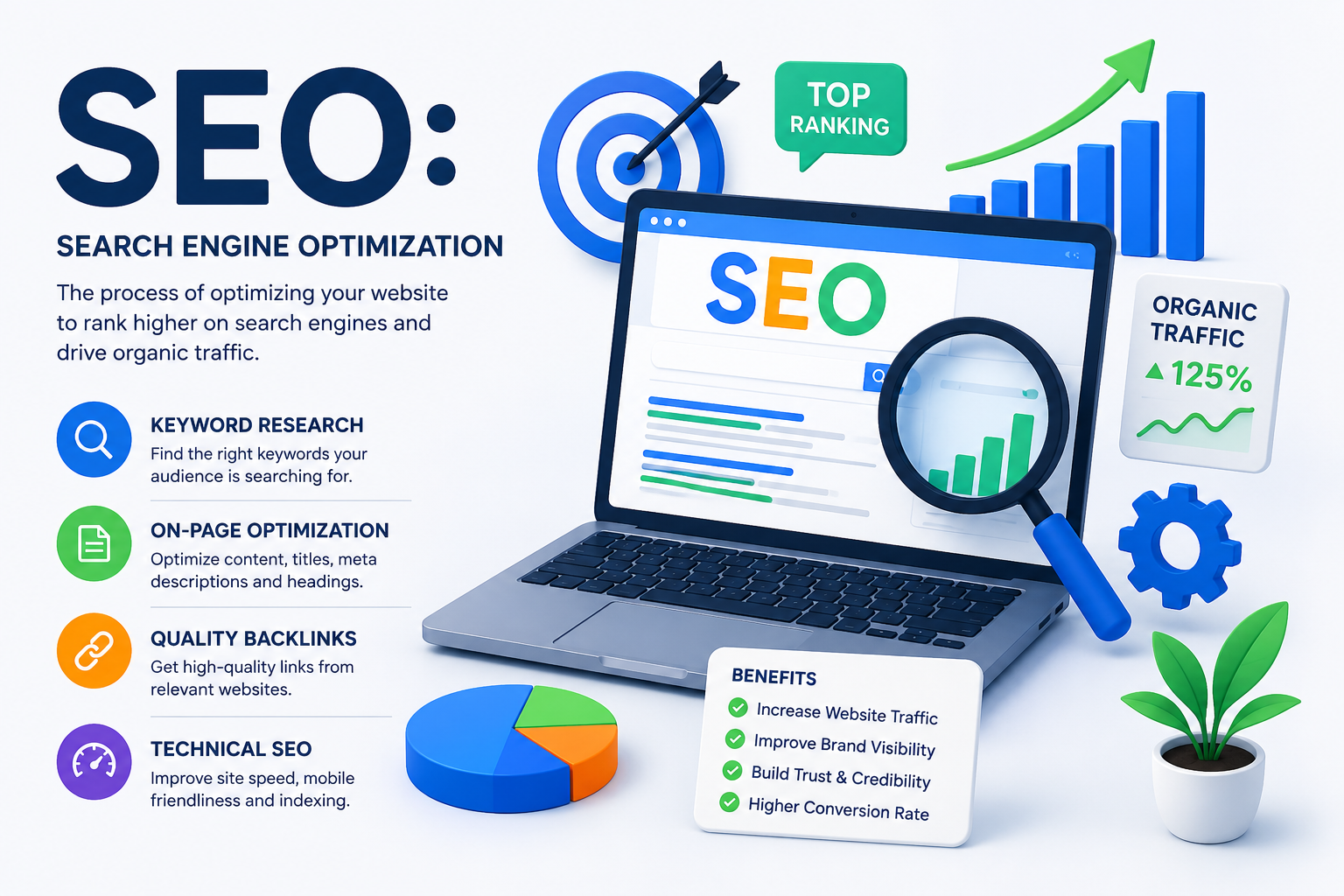
SEO offers several benefits:
Increases organic website traffic
Builds trust and credibility
Improves user experience
Generates long-term results
Reduces advertising costs
Increases conversions and sales
Businesses that invest in Search Engine Optimization often receive consistent visitors for months or even years after publishing quality content.
How Search Engines Work
Search engines follow three basic steps:
1. Crawling
Google bots discover new pages across the web.
2. Indexing
The pages are stored in Google’s database.
3. Ranking
Google decides which pages deserve to appear first based on hundreds of ranking signals.
Types of Search Engine Optimization
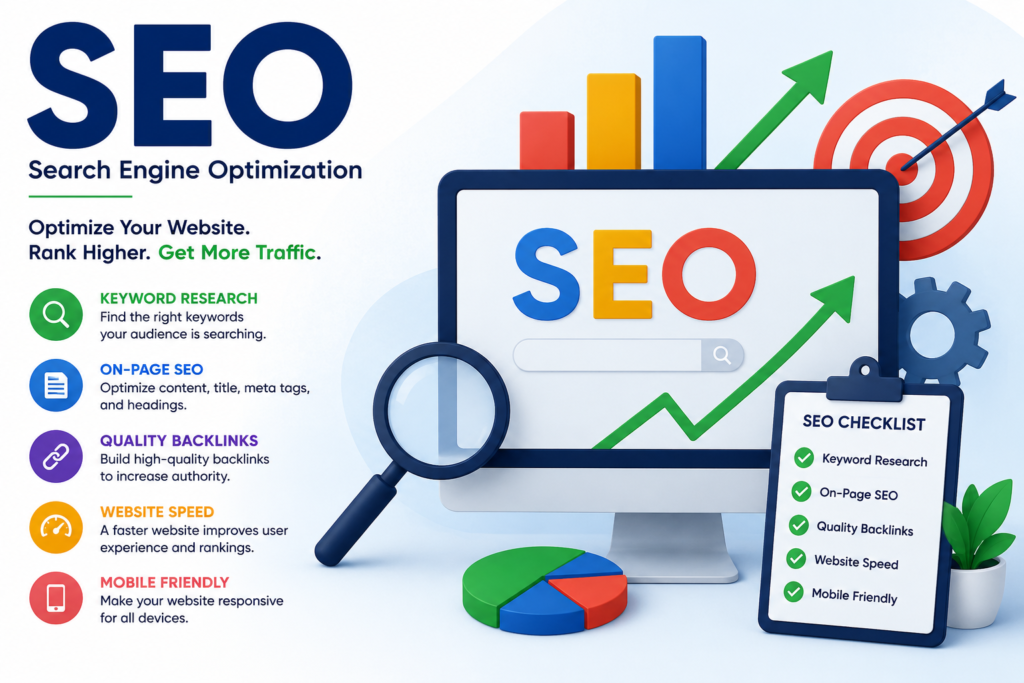
1. On-Page SEO
On-page focuses on optimizing your content.
Examples include:
2. Off-Page SEO
Off-page improves your website’s authority through:
Quality backlinks
Brand mentions
Guest posting
Social media exposure
Digital PR
3. Technical SEO
Technical helps search engines crawl your website efficiently.
Important factors include:
Fast loading speed
Mobile-friendly design
HTTPS security
XML sitemap
Robots.txt
Structured data (Schema)
Core Web Vitals
Keyword Research
Keyword research is the foundation of Search Engine Optimization.
Choose keywords based on:
Example keywords:
What is SEO?
SEO for beginners?
Best SEO strategies?
Technical SEO guide?
On-page SEO checklist?
How to rank on Google?
Write Helpful Content
Google rewards content that genuinely helps readers.
Your content should:
Avoid keyword stuffing. Write naturally for people first.
Image Search Engine Optimization
Optimize every image by:
Using descriptive filenames
Adding alt text
Compressing images
Using modern formats such as WebP
Including relevant captions where appropriate
Internal Linking
Internal links help users and search engines discover more of your content.
For example:
Build High-Quality Backlinks
Backlinks remain one of the strongest ranking signals.
Good ways to earn backlinks:
Publish original research
Create detailed guides
Guest post on reputable websites
Produce useful tools or templates
Share valuable resources people want to reference
Common Search Engine Optimization Mistakes
Avoid these mistakes:
Search Engine Optimization Trends in 2026
Stay competitive by focusing on:
Helpful, people-first content
User experience (UX)
Fast page speed
AI-assisted content with human editing
Topical authority
Structured data
E-E-A-T (Experience, Expertise, Authoritativeness, and Trustworthiness)
Frequently Asked Questions (FAQs)
What is SEO?
Search Engine Optimization is the process of improving a website’s visibility in search engine results to increase organic traffic.
Is SEO free?
Organic traffic is free, but Search Engine Optimization requires time, expertise, and ongoing effort.
How long does SEO take?
Many websites begin seeing meaningful improvements within 3–6 months, though competitive niches can take longer.
Which is better: SEO or Google Ads?
Search Engine Optimization provides long-term organic growth, while Google Ads can deliver immediate traffic. Many businesses use both.
What is On-Page SEO?
On-page includes optimizing content, titles, headings, images, internal links, and HTML elements.
What is Technical SEO?
Technical Search Engine Optimization ensures your website is easy for search engines to crawl, index, and render.
Why are backlinks important?
High-quality backlinks can improve your site’s authority and help it rank for competitive keywords.
Does AI content rank on Google?
AI-assisted content can rank if it is accurate, original, helpful, and genuinely satisfies user intent.
Final Thoughts
Search Engine Optimization is a long-term strategy rather than a quick trick. Focus on creating helpful content, understanding search intent, improving user experience, and maintaining a technically sound website. Over time, this approach can build sustainable organic traffic and stronger search visibility.