Why E-commerce Sellers Are Turning to AI
Before jumping into specific tools, it’s worth understanding why this shift is happening so quickly. Industry analysts project that by the end of 2026, more than three-quarters of e-commerce businesses will rely on AI automation for at least one core function. Meanwhile, global spending on AI systems is expected to climb well past $300 billion this year alone.
In short, this isn’t a passing trend — it’s quickly becoming the standard. And the businesses adopting it early are already seeing meaningful gains, with some studies pointing to operational efficiency improvements of up to 30%.
With that context in mind, let’s break down where AI is making the biggest difference.
1. AI for Customer Support
Arguably, customer support offers the fastest, most measurable return on investment of any AI application in e-commerce right now. After all, most customer questions — order status, return policies, shipping timelines — don’t require a human at all.
Top picks:
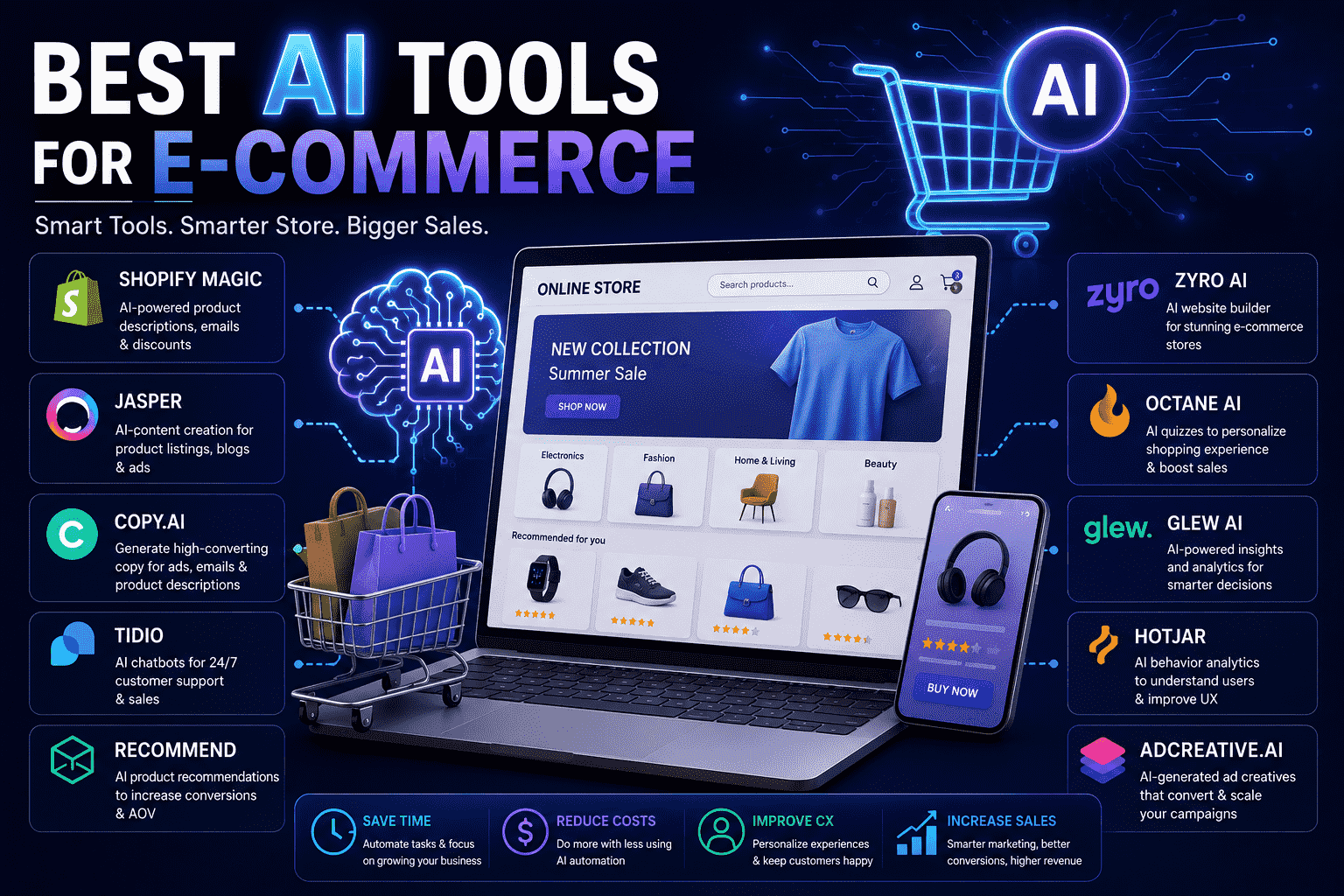
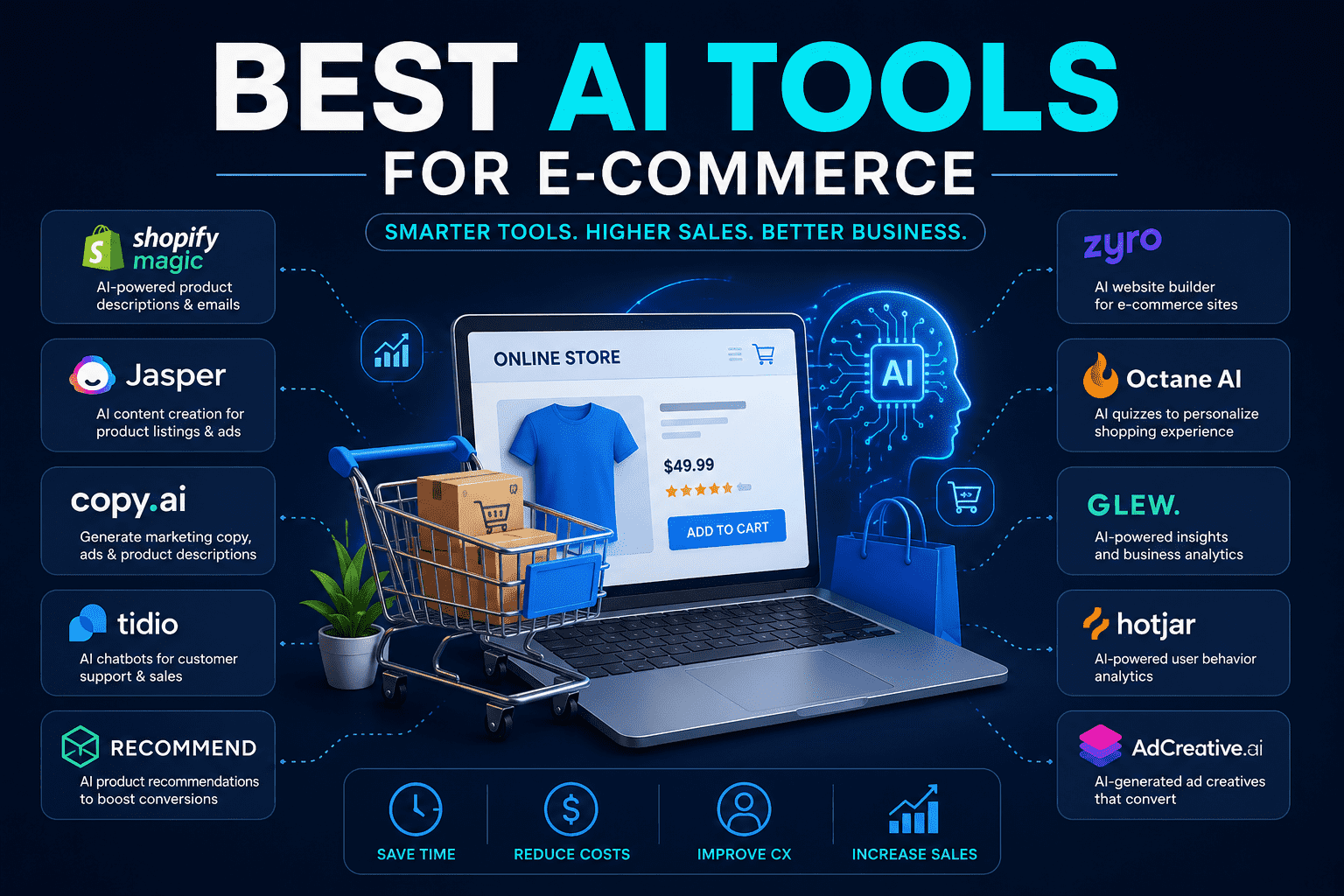
- Tidio — Its Lyro AI chatbot handles common customer questions, recommends products based on the conversation, and can even trigger post-purchase actions like shipping updates, all without human intervention.
- Chatbase — Built specifically for custom AI customer service chatbots that can be trained on your store’s own data.
Why it works: The vast majority of shoppers say they’re perfectly comfortable getting AI-powered answers to straightforward questions. So, instead of pulling your team away from higher-value work, a support chatbot lets them focus on the complex, judgment-based conversations that actually need a person.
2. AI for Content Creation
Next, let’s talk about content — because writing dozens (or hundreds) of product descriptions by hand is, frankly, one of the most tedious parts of running a store.
Top picks:
- Shopify Magic — Built directly into the Shopify admin, it generates product descriptions from a handful of keywords, writes email campaign copy, and even edits product images automatically.
- Jasper — A dedicated AI writing tool that’s especially strong for blog content, ad copy, and brand-voice consistency across channels.
Why it works: Rather than staring at a blank screen for every new listing, you can generate a strong first draft in seconds, then simply polish it to match your brand’s voice.
3. AI for Conversion & Personalization
Meanwhile, getting traffic to your store is only half the battle — the real challenge is turning that traffic into actual sales.
Top picks:
- OptiMonk — Uses AI to personalize on-site offers and popups based on visitor behavior, helping convert hesitant browsers into buyers.
- Algolia — Powers smarter, AI-driven site search and product recommendations, so shoppers find what they want faster instead of bouncing.
Why it works: Personalization at scale used to require a large data team. Now, these tools do the heavy lifting automatically, adjusting in real time to each visitor’s behavior.
4. AI for Email & CRM Marketing
Similarly, email remains one of the highest-ROI marketing channels in e-commerce — and AI is making it dramatically more efficient.
Top picks:
- Klaviyo — Its AI features can build customer segments from plain-language descriptions and optimize send times individually for each subscriber, saving hours of manual setup.
- Omnisend — A strong alternative for smaller stores, combining email and SMS automation with AI-generated content suggestions.
Why it works: Instead of manually segmenting your list or guessing at send times, these platforms use behavioral data to automatically target the right customer with the right message at the right moment.
5. AI for Analytics & Pricing
Furthermore, pricing and inventory decisions are notoriously hard to get right by gut feel alone — which is exactly where AI tends to shine.
Top picks:
- Prisync — Tracks competitor pricing automatically and suggests adjustments to keep you competitive without constantly checking rival stores yourself.
- Conjura — Consolidates your store’s data into clear, actionable analytics, helping you spot trends before they become obvious.
Why it works: These tools remove the guesswork, allowing you to make pricing and inventory decisions based on real data instead of instinct.
6. AI for Product Photography
Finally, professional product photography has traditionally been expensive and time-consuming — but AI has changed that almost entirely.
Top picks:
- Photoroom — Generates clean, professional-looking product photos and removes backgrounds in seconds, no photo studio required.
- Shopify Magic (Image Editing) — Also handles background removal and touch-ups directly within your existing product listings.
Why it works: Instead of booking a photographer or building a home studio setup, you can produce polished, on-brand images in minutes — which is especially valuable for small shops just getting started.
How to Choose the Right AI Tools for Your Store
With so many options available, it’s easy to feel like you need all of them at once. However, that’s usually the wrong approach. Instead, follow this simple framework:
- Start with your biggest bottleneck. Whichever task is eating the most of your time right now is where AI will deliver the fastest, most noticeable impact.
- Weigh the cost against the time saved, not just the subscription price. If a $30/month tool saves you 10 hours a week, the real question isn’t whether it’s expensive — it’s what your time is actually worth.
- Avoid tool overload. Adding five new subscriptions at once often creates more confusion than clarity. So, start with one or two tools, measure the results, and expand from there.
- Prioritize integration. A tool that connects directly with Shopify, WooCommerce, or your existing platform will always save you more headaches than one that requires manual workarounds.
Final Thoughts
Ultimately, AI isn’t about replacing the work you do — it’s about clearing away the repetitive tasks so you can focus on the parts of your business that actually require your judgment and creativity. Rather than chasing every new AI tool that launches, start with whichever problem is costing you the most time right now, solve it well, and build your stack from there.
Because in the end, the goal was never to use more tools. It was always to run a better store.
Curious how AI can help with product research too? Check out our guide on 50 Profitable Etsy Niches to pair smart tools with a smart niche.