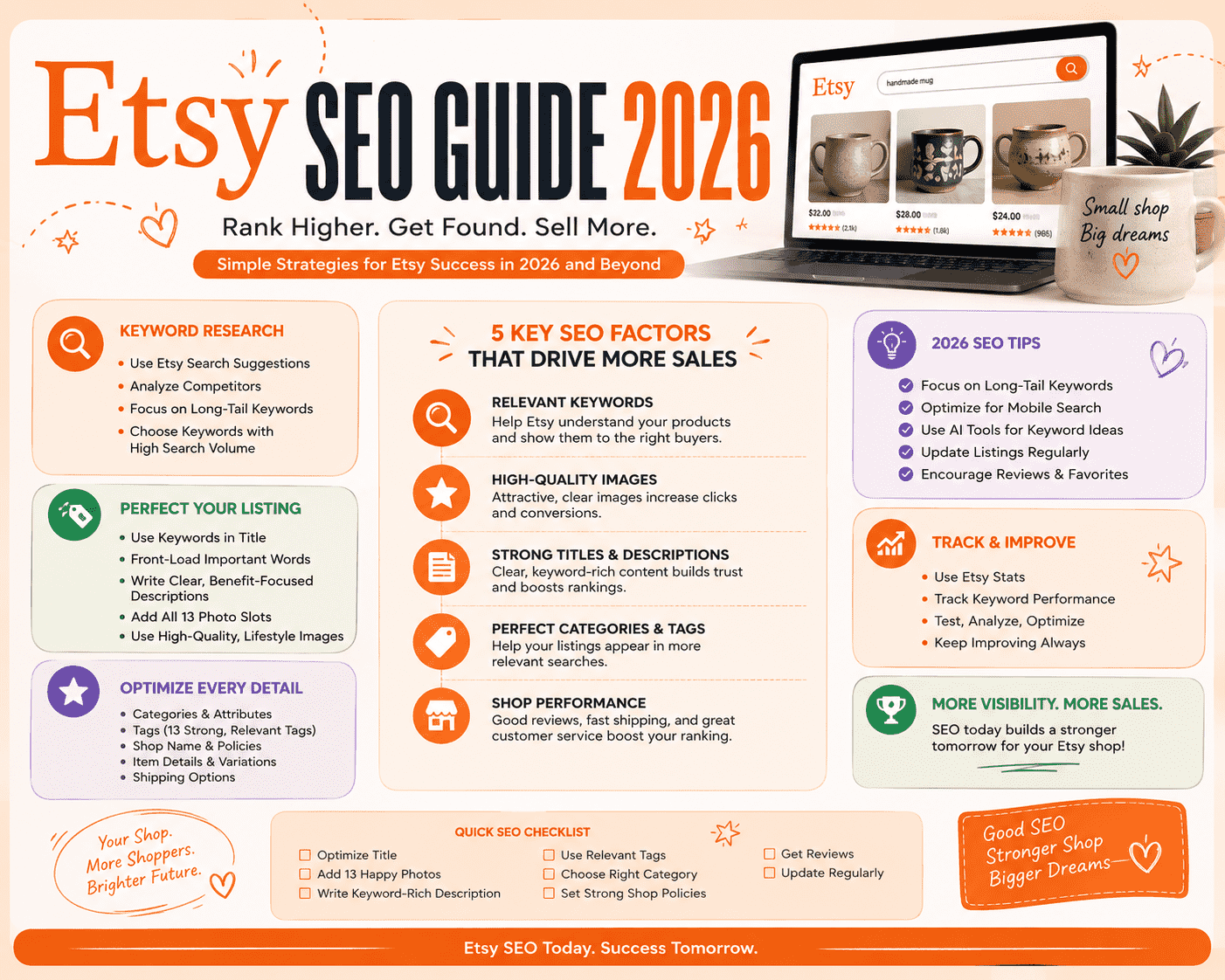
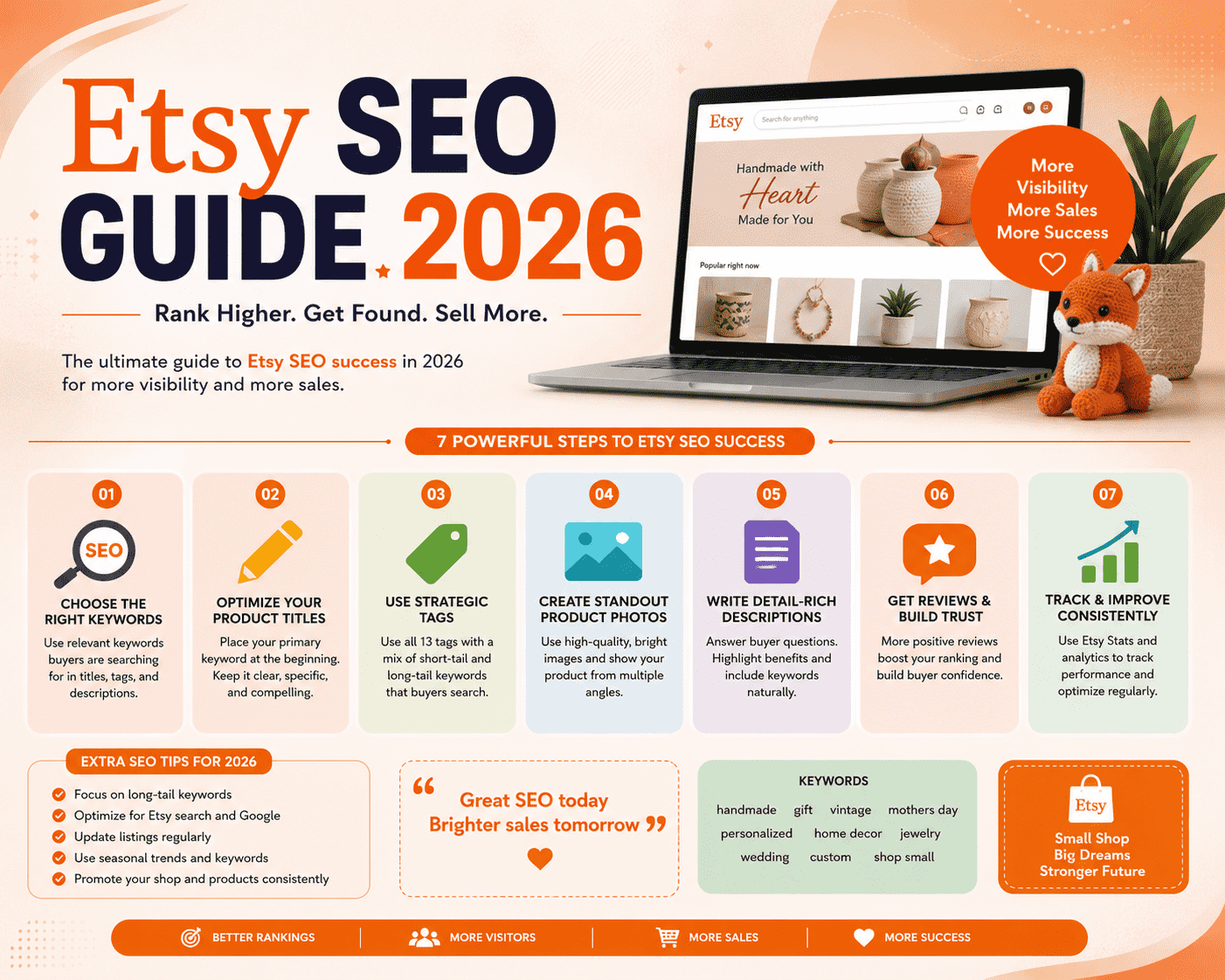
How Etsy’s Search Algorithm Actually Works
Before you touch a single listing, it helps to understand what’s happening behind the scenes. Essentially, Etsy’s algorithm ranks products in two separate stages.
First, there’s query matching. When a shopper types in a search term, Etsy scans your title, tags, category, and attributes to decide whether your listing is even eligible to appear. In other words, if your listing doesn’t clearly contain the words a buyer searched for, it may never make it into the running at all.
Second, there’s ranking. Once your listing qualifies, Etsy determines where it appears by looking at how likely it is to convert — meaning your click-through rate, your favorites, your sales history, and even how long shoppers linger on your listing after clicking. So, in short, getting found is only step one. Etsy keeps rewarding listings that actually earn clicks and purchases, not just the ones stuffed with keywords.
With that foundation in place, let’s walk through exactly how to optimize for both stages.
Step 1: Do Real Keyword Research
Rather than guessing what buyers might search for, let the platform tell you directly. Type your main product idea into Etsy’s search bar and pay close attention to the autocomplete suggestions that appear — these come straight from real buyer searches.
From there, open the top-performing listings for that keyword and scroll to their tags. Consequently, you’ll start noticing patterns: certain phrases show up again and again across top sellers. Those repeated terms are proven winners, and they’re exactly what you should be building your own listing around.
Quick tip: Favor specific, descriptive long-tail keywords (“personalized birthstone necklace for mom”) over broad, generic ones (“necklace”). Not only do long-tail keywords face far less competition, but they also tend to match exactly what a ready-to-buy shopper is searching for.
Step 2: Write Keyword-Rich, Human-Friendly Titles
Your title carries more ranking weight than almost anything else on your listing — so it deserves real thought, not an afterthought.
That said, avoid the old-school trap of keyword-stuffing (“Necklace Gift Women Jewelry Necklace Silver Necklace Gift”). Instead, write a natural-sounding title that still front-loads your most important keywords. For example, “Personalized Name Necklace, Custom Birthstone Jewelry, Gift for Her” reads naturally and hits multiple valuable search terms at once.
Ultimately, if a real person can read your title out loud without cringing, you’re on the right track.
Step 3: Use All 13 Tags Strategically
Etsy gives you 13 tags per listing — and leaving even one blank is a missed opportunity. Each tag acts as an additional chance to match a buyer’s search query, so treat them as prime real estate, not an afterthought.
To fill them effectively:
- Use multi-word phrases rather than single, generic words (buyers rarely search “necklace” alone)
- Avoid repeating words already in your title — instead, use tags to capture variations and synonyms
- Reference what’s working for top-ranking competitors in your niche
- Include occasion-based tags where relevant (“gift for mom,” “birthday gift,” “anniversary gift”)
Step 4: Optimize Your Categories and Attributes
Here’s something a lot of sellers overlook: categories and attributes function almost like hidden tags. So, whenever Etsy asks you to select a color, material, occasion, or style during listing setup, fill in every relevant field — don’t skip past them.
Because these details feed directly into Etsy’s query-matching system, an incomplete listing is quite literally leaving ranking potential on the table.
Step 5: Prioritize Your Photos (and Consider Video)
Even if your SEO is flawless, weak photos will quietly sabotage your rankings. Why? Because Etsy tracks click-through rate as a ranking signal — and if shoppers scroll right past your first image, your listing simply won’t climb.
As a result, your first photo needs to stop the scroll: bright, high-contrast, and instantly clear about what you’re selling. From there, follow up with lifestyle shots, different angles, and close-ups that show texture or scale.
On top of that, video has become a genuine ranking factor rather than a nice-to-have. Since Etsy’s mobile search results now auto-play video previews, listings with video tend to hold attention longer — and that extra “dwell time” signals quality to the algorithm.
Step 6: Write Descriptions for Buyers, Not Just Robots
While your description carries less ranking weight than your title or tags, it still matters — both for conversion and for search context. So, treat the first sentence or two like a mini-title: natural, specific, and keyword-aware.
After that opening line, shift your focus toward the buyer. Answer their obvious questions clearly: What’s it made of? What sizes or customization options are available? How long does it take to ship? Because a clear, honest description reduces confusion (and refunds) — and fewer refunds directly support a stronger listing quality score.
Step 7: Price Competitively (Without Underpricing)
Interestingly, pricing itself influences your ranking. If you price dramatically below the category average, Etsy may interpret it as a spam signal. On the other hand, pricing too high without the reviews or photos to back it up can tank your conversion rate — which hurts you just as much.
So, aim to stay within roughly 20% of your category’s average pricing, unless your photos, reviews, and positioning are strong enough to justify a premium.
Step 8: Focus on Engagement, Not Just Keywords
Here’s the part many sellers miss entirely: in 2026, Etsy weighs buyer behavior more heavily than ever. Click-through rate, add-to-cart activity, and completed purchases now carry serious influence over your ranking — sometimes even more than perfect keyword placement.
Therefore, a listing that’s clicked and purchased consistently will often outrank a “perfectly optimized” listing that nobody engages with. In short, Etsy SEO isn’t just about being found anymore — it’s about earning genuine buyer trust once you are.
Step 9: Drive External Traffic
Finally, don’t rely on Etsy’s internal search alone. When shoppers arrive at your listing from Pinterest, TikTok, or Google, Etsy’s algorithm reads that external interest as a positive trust signal — which, in turn, can boost your internal search ranking too.
So, sharing your listings on social platforms isn’t just about generating a one-time sale. Rather, it’s an indirect way of strengthening your Etsy SEO at the same time.
Common Etsy SEO Mistakes to Avoid
- Keyword-stuffing titles instead of writing naturally
- Leaving tags blank or repeating the same words already in your title
- Skipping attributes during listing setup
- Constantly editing listings without a clear plan, which makes it impossible to track what’s actually working
- Relying only on renewals instead of improving photos, pricing, and engagement
- Ignoring video, even though it’s increasingly rewarded on mobile search
Final Thoughts
At the end of the day, Etsy SEO isn’t a one-time task you check off and forget. Instead, it’s an ongoing process — one where you research, optimize, monitor performance, and adjust based on real data. The sellers who treat it that way are consistently the ones who climb Etsy’s search results and stay there.
So, rather than trying to fix everything at once, start small: pick your five lowest-performing listings, apply what you’ve learned here, and build from that momentum.
Not sure which products to optimize first? Check out our guide on the Top 50 Best-Selling Etsy Products to find high-demand ideas worth ranking for.